Key Takeaways
- A contextual link is a hyperlink placed naturally inside body content — within a paragraph, surrounded by relevant text. It's the link type that carries the most weight for rankings and AI visibility.
- Search engines use NLP to evaluate the words around every hyperlink. A reference inside an editorial paragraph sends a far stronger relevance signal than a sidebar listing, footer link, or directory placement.
- In 2026, contextual links do double duty: they pass ranking authority and create the editorial brand mentions that AI systems — ChatGPT, Perplexity, Gemini, and Google AI Overviews — rely on for citation decisions.
- Where on a page a link sits matters as much as whether the page links to you. Google weights links inside main content (the "centerpiece" of a page) far more heavily than nav, sidebar, or footer placements.
- The most scalable method for earning contextual links is digital PR — where journalists reference your brand inside real editorial content they write for their own publications.
If you've spent any time building links, you already know the basics: not all backlinks are equal. But the gap between link types is wider than most people realize — and it's getting wider.
A hyperlink buried in a sidebar widget, a footer blogroll, or a "write for us" author bio doesn't carry the same signal as one placed naturally inside a paragraph by a journalist who's actually writing about your topic. That in-content reference is a contextual link. It's what Google's algorithms weight most heavily, what AI search systems use to decide who to cite, and what separates profiles that compound over time from profiles that flatline.
This guide breaks down what makes contextual links different, why they matter more in 2026 than ever, and the strategies that actually work for building them.
What Are Contextual Links?
A contextual link is a hyperlink embedded within the main body content of a page — inside a paragraph, surrounded by sentences that provide context about what the link points to and why it's relevant.
You'll see the same thing called contextual backlinks, in-content links, or in-context links — the terms are interchangeable. "Contextual link" describes any in-body hyperlink; "contextual backlink" usually means one pointing at your site from someone else's. Internal contextual links (between pages on your own site) pass the same kind of relevance signal — external ones just carry another site's authority with them.
Here's a concrete example. A health publication writes about workplace wellness trends. Within a paragraph about employee mentoring programs, the journalist includes a reference to a SaaS platform that powers mentoring workflows. That link sits inside relevant editorial content, uses descriptive anchor text, and was placed because it genuinely supports the point being made. That's a contextual link.
Now compare that to the same platform listed in a sidebar "Resources" widget, a footer directory, or an author bio at the bottom of a guest post. Those are non-contextual placements. They lack the surrounding editorial context that makes a link actually valuable.
The distinction isn't subtle. Different placements get treated very differently by both search engines and AI systems:
| Placement type | What Google evaluates | What AI search evaluates |
|---|---|---|
| In-content (editorial paragraph) | Strong — full relevance signal from surrounding text and page topic | Strong — counts as an editorial brand mention |
| Sidebar / "Resources" widget | Weak — supplemental, not main content | None — no editorial context |
| Footer / blogroll / directory | Minimal — boilerplate | None |
| Author bio (guest post) | Modest — flagged as self-referential | Limited |
Search engines and AI systems don't just count links anymore. They read the words around each one — and where the link lives on the page.
Why They Matter More in 2026
Contextual links have always been the most valuable link type. That's not new. What's new is how much more valuable they've become — because of three shifts happening simultaneously.
Google's NLP is reading what surrounds every link
Search engines evaluate the sentences around each hyperlink — the paragraph topic, the section heading, the overall page theme. A reference to "mentoring software" inside a 2,000-word article about employee development sends a dramatically stronger relevance signal than the same reference stuffed into a random blogroll.
Google has described this structurally. In a 2021 Duda webinar, Martin Splitt (Google's Developer Relations team) walked through what Google calls "Centerpiece Annotation" — Google identifies the main content area of a page (the "centerpiece") and weights it differently than boilerplate elements like navigation, sidebars, related-product widgets, and footers. Links sitting inside the centerpiece carry the full weight of Google's relevance evaluation. Links sitting outside it get weighted lightly.
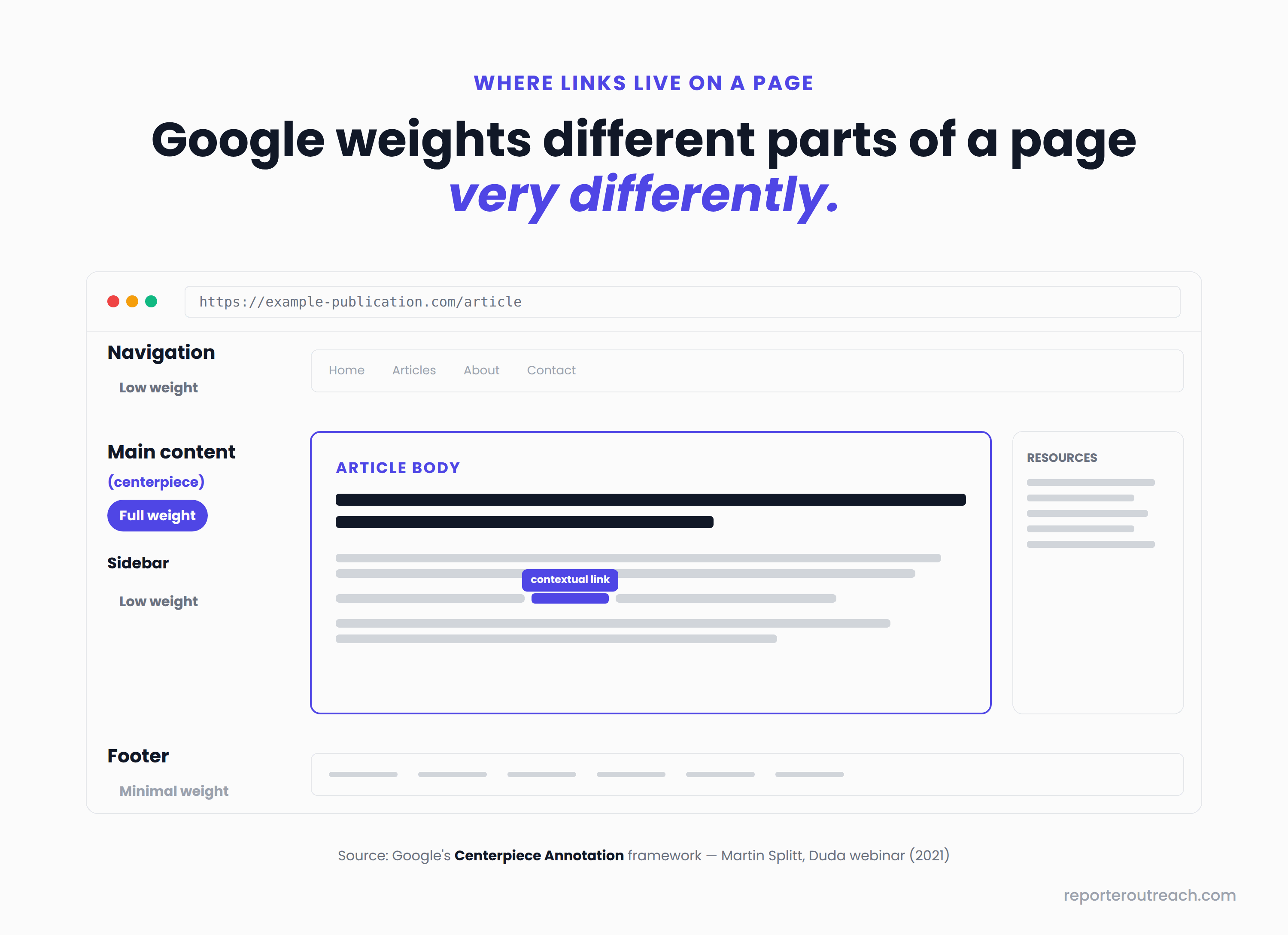
Links placed higher in body content tend to carry more weight too — partly because users are more likely to encounter and click them, partly because earlier paragraphs typically establish the topical relevance of the page. The first in-content reference on a page often passes the most authority.
AI search uses editorial context to decide who to cite
This is the shift most guides miss entirely.
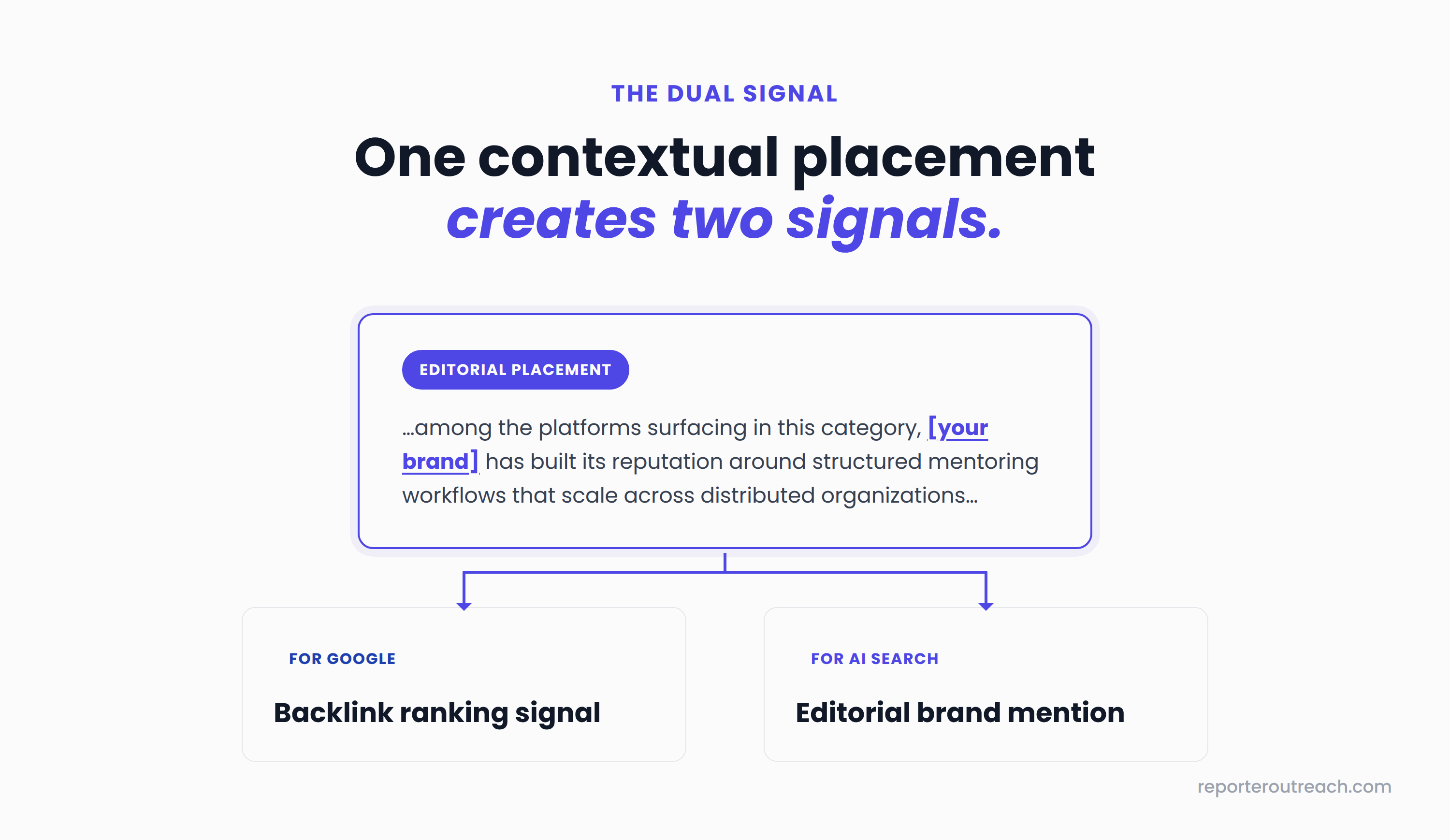
ChatGPT, Perplexity, Gemini, and Google AI Overviews don't just evaluate whether your site has backlinks. They evaluate whether your brand is mentioned in context within editorial content across the web. When a journalist writes about mentoring trends and references your platform by name inside their article, that creates two signals simultaneously: a backlink for Google and an editorial brand mention for AI.
A directory listing generates zero brand mentions. A footer link generates zero. A contextual placement inside a Forbes feature? That generates exactly the signal AI systems weight most heavily. For a deeper look at how AI search picks who to cite, see our guide on generative engine optimization.
This isn't theoretical visibility loss. Pew Research's July 2025 study of 900 US adults found that 26% of users end their browsing session entirely after seeing an AI summary in search, compared to 16% without one. If your brand isn't the one mentioned inside that AI summary, the user often never reaches your competitors' page either — the entire session ends at Google.
Ahrefs' analysis of 75,000 brands found that brands in the top quartile by web mention volume earn roughly 10x more AI Overview mentions than the next quartile — and brands in the bottom 50% by mention volume are essentially invisible to AI systems. Meanwhile, Ahrefs' December 2025 follow-up study reports that AI Overviews now reduce position #1 click-through rate by 58% (up from 34.5% in their original April 2025 analysis). If your link profile is built on directories and PBNs, you're invisible to the fastest-growing segment of search.
Spam detection is catching up to non-contextual manipulation
Google's SpamBrain — first deployed specifically against link manipulation in the December 2022 link spam update — is increasingly effective at identifying and devaluing the patterns that defined a decade of link building: PBNs, excessive reciprocal linking, paid placements in thin "link farm" articles, random footer links from unrelated sites. These tactics worked five years ago. They're liabilities now.
Contextual links earned through editorial relationships are algorithmically safer because they look exactly like what Google wants to reward — a real author writing real content and referencing a resource that supports their point. There's nothing to detect because there's nothing artificial about the placement.
What Makes a Good Contextual Link?
A hyperlink inside a 200-word article on a site with no traffic is technically "contextual." It's also nearly worthless. The placement alone isn't enough — the context around it has to be real.
Here's what actually separates high-impact contextual placements from weak ones:
| Strong contextual link | Weak (or counterproductive) link |
|---|---|
| Sits inside an editorial paragraph on a topically related page | Lives in a sidebar, footer, or "Resources" list |
| Surrounding text describes what your resource adds to the discussion | Surrounding text is unrelated to your content |
| Anchor text is descriptive, not generic ("click here") | Anchor text is exact-match keyword on every placement |
| Site has real organic traffic, not just a high DR score | DR is high but traffic is suspiciously low (link farm signal) |
| Page is on a publication with editorial standards | Page exists primarily to publish guest posts |
| Article was written for the publication's audience, not for the link | Article reads like it was written to host a link |
How to Build Contextual Links
Six legitimate ways to build contextual backlinks, ranked by ROI and scalability based on what we've seen across hundreds of campaigns. They're not all equal.
1. Digital PR
This is the highest-ROI method. Full stop.
Digital PR earns contextual links by positioning your brand as an expert source on topics journalists are already writing about. When a reporter at a major publication writes a story and references your brand within the body content, that's the gold standard: editorial, relevant, and paired with a brand mention that feeds both Google and AI.
A single campaign can generate 10-50+ placements across unique domains. Reporter Outreach's average placement lands on a site with DR 75+. Unlike guest posts, these come from content the publication's own writers create — which is inherently trusted because it went through an editorial process you don't control.
This is also the only strategy that simultaneously builds both the backlinks Google evaluates and the editorial brand mentions AI weights most heavily.
2. Linkable assets
Before any outreach, you need pages worth referencing. Original research, data studies, free tools, and comprehensive guides give other publishers a reason to link to you — not as a favor, but because your content genuinely supports what they're writing.
Data-driven content works especially well. An original survey or industry study gives journalists and bloggers something citable. Statistics pages ("X Industry Statistics for 2026") consistently attract contextual links because writers need data to support their claims — and citing your research is a natural editorial decision, not a transaction.
3. Niche edits (link insertions)
Niche edits involve adding your link to existing, already-published content on relevant sites. Because the page is already indexed and may already have its own authority and backlink profile, the value passes faster than it would from a brand new page.
The key is relevance. The best insertions are placed within topically related paragraphs where your link genuinely adds value for the reader. An article about project management practices could naturally benefit from a reference to your collaboration tool. The worst are forced links jammed into unrelated paragraphs on low-quality sites — those are easy to spot and increasingly penalized.
Real example: Nightfall, a cybersecurity SaaS platform, grew organic traffic 123% in 13 months through 57 link insertions placed across relevant tech sites. Every link sat inside existing editorial content where the surrounding context aligned naturally with their product category — that's the difference between a niche edit that compounds and one that gets discounted.
4. Guest contributions (on the right sites)
Guest posting still produces contextual links, but the margin between "effective" and "penalty risk" is razor thin. The approach that works: contribute genuinely valuable content to publications with real editorial standards, organic traffic, and an engaged readership. One well-placed link per post. Descriptive anchor text.
The approach that doesn't: mass-producing thin articles for sites that publish 50 guest posts a week and exist primarily to sell placements. Google's SpamBrain is specifically trained to identify these networks. If the site has a "write for us" page that reads like a pricing menu, walk away.
5. Broken link building
Find pages on authoritative sites that reference resources which now return a 404. Contact the site, flag the broken link, and suggest your relevant page as a replacement. You're solving a problem — broken links create a bad experience for their readers — while earning a contextual placement for yourself.
Tools like Ahrefs and Screaming Frog make finding these opportunities straightforward. Focus on broken references from high-DR sites in your niche. The conversion rate is lower than other methods, but the links you earn this way are genuinely editorial.
6. Unlinked brand mention reclamation
Your brand may already be mentioned across the web without a hyperlink attached. Use Ahrefs Content Explorer or Google Alerts to find pages that reference your brand name but don't include a link. A simple outreach email converts these at a high rate because the editorial mention already exists — you're just asking them to make it clickable.
Compared at a glance:
| Method | What it gets you | Best when |
|---|---|---|
| 1. Digital PR | Editorial placements on high-DR publications + brand mentions AI cites | You want both ranking authority and AI visibility, at scale |
| 2. Linkable assets | Inbound contextual links from writers citing your content | You have data, tools, or research worth referencing |
| 3. Niche edits | Insertions into already-indexed pages with existing authority | You want faster authority transfer with topical relevance |
| 4. Guest contributions | One contextual link per quality publication | You can produce useful content for editorial-standard sites |
| 5. Broken link building | Replacement links from authoritative sites | You have a comprehensive resource that fits a 404'd reference |
| 6. Brand mention reclamation | Hyperlinks added to existing brand mentions | You're already mentioned across the web without a link |
Common Mistakes That Kill Value
Over-optimized anchor text. Using exact-match keyword anchors on every placement triggers spam filters fast. A natural anchor profile includes branded terms (your company name), topical phrases, partial matches, and generic text. As a common practitioner heuristic, auditors aim to keep exact-match under 10% of total profile — this isn't a Google-published threshold, but it's a useful guardrail.
Buying from link farms. If a site publishes 50 "guest posts" a week, has a prominent "write for us" pricing page, and shows low traffic despite a decent DR — it exists to sell links, not to publish content. Google's SpamBrain is specifically trained to identify these networks. The placements look contextual on the surface but carry real penalty risk.
Ignoring topical relevance. A link from a pet care blog to your cybersecurity platform provides almost zero value regardless of the DR. The surrounding content needs to be related to what you do. Relevance isn't optional — it's what makes a contextual link contextual in the first place.
Chasing volume over quality. Ten editorial placements from DR 60+ publications will consistently outperform 100 placements from guest post mills. The data backs this up: Internet Marketing Ninjas' analysis of 1,113 top-ranking sites across 200 commercial phrases found that 96% of pages in Google's top 10 have more than 1,000 backlinks from unique domains — but the links separating them from everyone else are overwhelmingly editorial contextual placements, not directories or footer listings.
Neglecting internal links. External links get all the attention, but your internal linking structure matters too. Every blog post should reference 3-5 related pages on your site. This helps Google understand your topical clusters, distributes authority across pages, and keeps readers engaged longer.
Frequently Asked Questions
What is a contextual link in SEO?
It's a hyperlink placed inside the body content of a page — within a paragraph, surrounded by sentences that tell search engines what the linked resource is about. Google's NLP algorithms evaluate that surrounding text to assign relevance, which is why in-content references carry significantly more ranking weight than links found in sidebars, footers, or directories.
Why are contextual links more valuable than other types?
Two reasons. First, the surrounding editorial text gives search engines a rich relevance signal that sidebar or footer placements simply can't provide. Second — and this is the 2026 angle — editorial placements create brand mentions that AI systems like ChatGPT, Perplexity, Gemini, and Google AI Overviews use when deciding who to cite. Non-contextual links generate neither the full relevance signal nor the brand mention.
What's the best way to build contextual links at scale?
Digital PR. It's the only method that consistently produces editorial placements on high-authority publications (avg. DR 70+) at volume — one campaign can generate dozens of placements. Other strategies like niche edits and broken link building work as supplements, but nothing else matches digital PR's combination of quality, scalability, and safety from algorithm penalties.
How many contextual links do I need to rank?
It depends entirely on your competitive landscape. One useful data point: across the 200 commercial search phrases analyzed by Internet Marketing Ninjas, only 0.3% of top-10 sites had fewer than 100 backlinks from unique domains. The practical implication is "more authoritative sources referencing you than your competitors have" — but quality matters far more than raw count. A handful of DR 60+ editorial placements often outperforms hundreds of low-quality alternatives.
What's the difference between contextual links and niche edits?
Niche edits are one method of building contextual links. A niche edit places your reference into an already-published page. The result is a contextual link because it sits within body content. Digital PR, guest contributions, broken link building, and brand mention reclamation are other methods — they all produce contextual placements through different approaches.
Are contextual backlinks the same as contextual links?
Yes — a contextual backlink is simply a contextual link that points to your website from another site. Marketers say "backlink" when talking about links they receive, but the placement being described is identical: an in-content hyperlink surrounded by relevant editorial text. Internal contextual links exist too — they connect pages within your own site and help distribute authority.
Do contextual links help with AI search visibility?
Yes, and this is increasingly the primary reason to prioritize them. AI systems decide who to cite based on editorial brand mentions across the web. When a journalist references your brand inside their article, that creates both a backlink (for Google) and a brand mention (for AI). Ahrefs' analysis of 75,000 brands found that brands in the bottom 50% by web mention volume are essentially invisible to AI systems, while top-quartile brands earn roughly 10x more AI Overview mentions than the next quartile. Contextual links through digital PR are the most direct path to visibility across both traditional and AI-powered search.
Build Links That Google and AI Trust
We earn editorial contextual links from real publications — the type that improves rankings, drives referral traffic, and gets your brand cited by AI.
Sources
- Internet Marketing Ninjas — "Backlink Insights: Analyzing Google's Top 10 Websites" (1,113 sites, 200 commercial phrases, 2024)
- Ahrefs — "An Analysis of AI Overview Brand Visibility Factors" (75,000 brands, branded web mention correlation study)
- Ahrefs — "Update: AI Overviews Reduce Clicks by 58%" (Ryan Law, December 2025 data, February 2026)
- Pew Research Center — Study on AI summaries and online search behavior (900 US adults, July 2025)
- Search Engine Journal — Coverage of Martin Splitt's "Centerpiece Annotation" framework (Duda webinar, 2021)
- Google Search Central — December 2022 Link Spam Update / SpamBrain documentation