Key Takeaways
- Niche edits (also called link insertions) place your backlink into an existing, already-indexed article on a relevant site. No new content creation needed.
- They deliver faster results than guest posts because the host page already carries authority, backlinks, and crawl history. Google picks up the new link quickly.
- Most insertions on real, trafficked sites cost $200 to $600 per link, depending on the host site's DR and traffic. Ours are $300 (DR 50+), $400 (DR 60+) and $500 (DR 70+), each with a minimum organic traffic floor.
- Quality control determines everything. Host site traffic predicts placement impact better than DR. A high-DR site with no traffic is worse than a mid-DR site with a real audience.
- Niche edits are the direct route to ranking specific pages in Google, and pages that rank feed the sources AI tools pull from. Pair them with digital PR, which builds the editorial brand mentions AI tools weigh most.
If you've spent any time researching link building, you've heard two terms used interchangeably: niche edits and link insertions. Same thing. You're placing a backlink into an existing, already-published article on someone else's site. No new content, no guest post pitch: just your link, added to a page that's already live and indexed.
It's one of the most effective tactics in link building. It's also one of the most abused.
The difference between a niche edit that moves your rankings and one that gets you nowhere (or triggers a penalty) comes down entirely to how you evaluate quality and where placements come from. This guide covers how the process works, what separates good placements from bad ones, what you should expect to pay, and how niche edits fit alongside digital PR in a 2026 SEO strategy.
What Niche Edits Actually Are
A niche edit is a backlink added to a page that already exists on a third-party website. The article is already written, already indexed, and already has its own authority. You're just adding your link to it.
Quick example: you run a SaaS company. There's a 2023 blog post on a marketing site titled "Best Project Management Tools for Remote Teams": DR 55, 3,000 monthly organic visitors, 40 referring domains pointing to it. You reach out to the site owner and arrange to have your tool added to the list with a contextual backlink. Your link lands on a page that already has authority and is already indexed, instead of starting from zero the way a new guest post does.
You'll also see them called link insertions, curated links, or contextual backlinks. All the same thing.
The name isn't accidental. The value of this tactic depends on topical relevance: your link needs to sit inside content that's closely related to what you do. A DR 45 page about HR software is a better target for an HR tool than a DR 70 page about cooking. Google's NLP evaluates the relationship between the linking page and your content. Irrelevant placements carry minimal value regardless of domain metrics.
How the Process Works
The concept is simple. Execution quality is where everything diverges. A provider identifies relevant pages on legitimate sites, vets them for traffic and topical fit, runs outreach to negotiate placement, and inserts your link into existing content where it makes sense contextually. The page is already indexed when your link goes live, so Google picks it up on the next crawl. Legitimate placements are standard dofollow links. Google treats nofollow as a hint not to pass ranking credit, so a nofollow insertion defeats the purpose.
The difference between a $200 placement and an $800 one isn't just the DR number. It's how much due diligence goes into evaluation. Cheap providers skip vetting entirely and pull from the same overused networks. You get a link on paper. You get nothing in practice.
The same diligence applies to anyone selling insertions: the vetting questions in our agency guide are how you confirm the quality control exists before the first invoice.
What Separates a Good Placement from a Bad One
This is where most people get burned. A niche edit is only as good as the page it lives on. Across our campaigns, the single best predictor of placement impact isn't DR. It's whether the host site has stable organic traffic from Google. Sites with consistent traffic, even modest, outperform high-DR sites with volatile or nonexistent traffic every time.

The reason holds up under scrutiny. An Internet Marketing Ninjas analysis of 1,113 top-ranking sites across 200 commercial phrases found that 96.3% of the sites ranking in the top 10 had links from more than 1,000 referring domains. Real ranking sites carry the kind of editorial backlink profile that takes years to build organically. Link farms with inflated DR don't have that profile. They have a handful of cross-linked sites in a closed network, the kind of pattern Google says its SpamBrain system is built to detect.
Here's what that translates into when evaluating individual placements:
| Signal | What it tells you |
|---|---|
| Stable Google organic traffic | Real audience. Google trusts the site enough to send it visitors. |
| Topical relevance to your niche | Google's NLP rewards links from contextually related content. The single biggest quality factor. |
| Editorial backlink profile | Real publications have years of organic links pointing at them, from varied sources. |
| Provider shows you the page first | Pre-approval is non-negotiable. If they won't show you, walk away. |
| Flat traffic line on Ahrefs | Site has no organic visibility. DR is metric inflation, not real authority. |
| Backlinks come from a small cluster | PBN signature. The site exists to sell links, not serve readers. |
| Placement under $30 with no traffic floor | Almost certainly PBN sourcing. Real low-DR sites with even modest traffic don't price that low. |
| Provider can't or won't pre-approve sites | Black-box link buying. The placement quality is whatever they can dump on you. |
Price alone isn't a reliable quality signal. The signal that actually matters is traffic. We won't approve a placement on a site under 1,000 monthly organic visitors regardless of DR. Below that floor, a site's authority is mostly notional. In our campaigns, sites without consistent traffic don't pass meaningful equity to your link, no matter what their domain metrics say.
Niche Edits vs. Guest Posts vs. Digital PR
The short answer: niche edits are the fastest way to put a link on a page that already has authority, which makes them the direct route to ranking a specific page. Guest posts trade that speed for control over the surrounding content. Digital PR is built to earn editorial brand mentions, the citations AI engines weigh most, along with domain-wide authority.
These are the three tactics that make up most professional link building campaigns. Each does something different, and understanding the trade-offs is how you decide where to allocate budget.
| Method | How it's priced | Speed | Best for |
|---|---|---|---|
| Niche edits | Per link, by the host site's DR and traffic | Fastest: the page is already indexed (ours go live within 2 to 3 weeks of approval) | Ranking a specific page you choose, with control of the anchor. Pages that rank also feed AI retrieval. |
| Guest posts | Per post, often with a writing fee | Slower: a new page has to be written, published and indexed | Topical links with control over the surrounding content |
| Digital PR | Monthly retainer | Campaign-driven | Domain-wide authority and the editorial brand mentions AI engines cite most |
The short version: Niche edits are the most direct way to place links on pages that already have authority. Guest posts start from zero, because the page is new. Digital PR delivers the highest-authority links (our placements average DR 75+) along with the journalist-written mentions that drive AI search visibility. Most serious campaigns use at least two of these together.
A quick note on the anchor text advantage. Unlike digital PR (where the journalist writes whatever they want), niche edits give you control over how the link text reads. That makes them useful for targeted campaigns where you need specific anchors pointing to specific pages. Just keep the distribution natural: no more than 10% exact-match keywords, heavy on branded and descriptive anchors.
What Niche Edits Actually Cost
Pricing tracks with the host site's authority and traffic. On public price lists, most insertions on real, trafficked sites fall between about $200 and $600. The HOTH, for example, lists DR 20+ insertions at $200, DR 45+ at $250 and DR 60+ at $450 (checked October 2026). Placements on top-tier, high-traffic publications run higher.
Our own niche edit services are priced per link by DR, and every tier has a minimum organic traffic floor:
| Tier | Host site traffic floor | Price per link |
|---|---|---|
| DR 50+ | 1,000+ organic visits a month | $300 |
| DR 60+ | 5,000+ organic visits a month | $400 |
| DR 70+ | 10,000+ organic visits a month | $500 |
Every tier: dofollow and never labeled sponsored, you approve every site and anchor, live within 2 to 3 weeks of approval, and free replacement if a link drops within 12 months. No retainer and no minimum.
The math behind those tiers is straightforward: one placement on a DR 55 site with 5,000 monthly visitors will outperform ten $30 links on zero-traffic sites. That's why we won't approve placements below the traffic floor regardless of price. For a full breakdown across all link building methods, see our link building pricing guide.
Providers offering placements under $30 with no traffic floor are almost always sourcing from PBNs or sites with inflated metrics. These aren't editorial sites with real audiences. They're networks built to sell links. The link looks fine in a report. It does nothing for your rankings and risks a penalty. In the $200 to $400 range you start seeing legitimate sites with genuine editorial standards. The jump in quality isn't incremental. It's night and day.
Three ways to source placements, each with different trade-offs. DIY prospecting means using Ahrefs Content Explorer to find relevant pages, filtering by DR and traffic, and emailing site owners directly. Expect 5 to 15% response rates and plan on 50 to 100 emails to build meaningful volume. Marketplaces skip the outreach but often pull from overused networks, so verify traffic independently before committing. Agencies handle the full process with quality control and replacement guarantees. Our managed link insertion service runs this model with a 1,000-visitor traffic floor on every placement. The premium you pay is for not having to vet every placement yourself. If you're an agency reselling placements to your own clients, our white label link building program runs the same vetting and inventory under your brand.
Niche Edits and AI Visibility
Niche edits build link equity and move specific pages in Google, and pages that rank are part of what AI tools retrieve from. What they don't create is the editorial brand mention AI search engines weigh most.
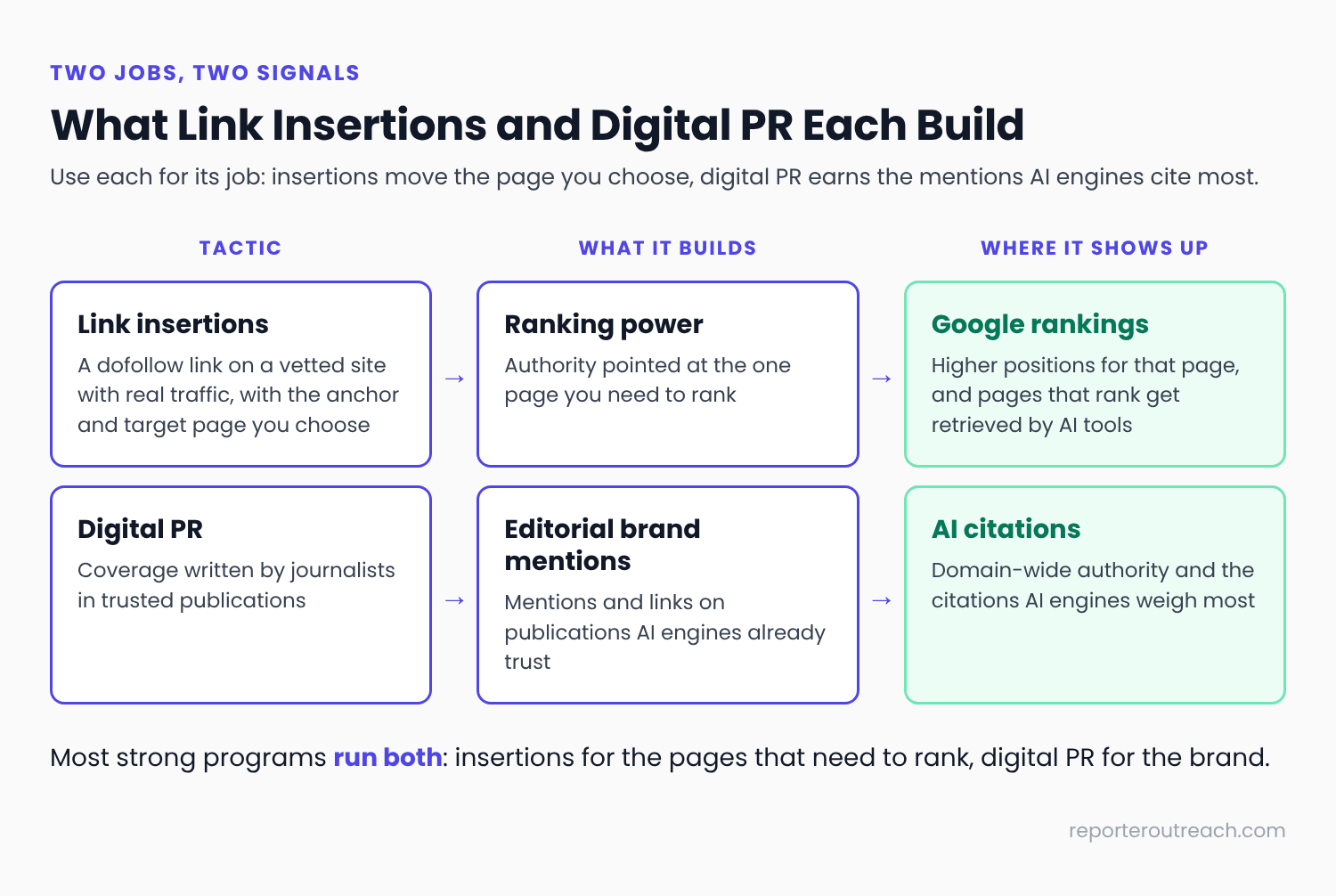
When ChatGPT, Perplexity, Gemini, or Google AI Overviews decide which brands to cite, they lean on editorial brand mentions across trusted publications: the kind that come from a journalist deciding your company is worth quoting. A niche edit gives you a backlink. It doesn't give you that mention. A digital PR placement gives you both.
If your entire strategy is niche edits, you're building rankings, and the AI retrieval that comes with them, but not the editorial mentions AI engines weigh most. The link equity from insertions still matters. Pair it with digital PR to cover both. See our GEO guide for the full breakdown.
How to Build a Strategy That Actually Works
Here's our take, after years of running campaigns: niche edits are a tool, not a strategy. The brands that win in 2026 don't pick one tactic. They use each one for what it does best.
| Tactic | What it does | When to use it |
|---|---|---|
| Niche edits | Targeted, fast-impact link placement with anchor text control. Capitalizes on existing high-authority pages in your niche. | When you need specific anchors pointing to specific pages, or want to direct equity to commercial pages quickly. |
| Digital PR | Editorial placements on high-authority publications (ours average DR 75+) with journalist-written brand mentions. The tactic built for the citation signals AI engines weigh most. | When you need authority, brand visibility and AI search presence, especially in trust-sensitive niches. |
| Full-feature articles | A full article about your brand on the DR 70 to 93 publication you choose, such as USA Today or VentureBeat. The deepest brand storytelling format, and it serves both SEO and credibility. | When you need in-depth expert positioning that neither insertions nor reactive PR can match. |
The brands climbing fastest in both traditional and AI search right now aren't all-in on any single tactic. They're running niche edits for the targeted link equity, digital PR for the authority and AI signals, and earned links from content that actually deserves to be linked to.
One of the biggest advantages of niche edits is anchor control, but that advantage turns into a liability if you over-optimize. Keep roughly 70% branded or URL anchors, 20% topical/descriptive, and no more than 10% exact-match. If every link pointing to your page uses the same keyword, Google notices. For a deep dive on managing your anchor distribution, see our backlink audit guide.
For a real-world example of this approach in action: Nightfall, a cybersecurity SaaS platform, grew organic traffic 123% in 13 months through 57 contextual link placements averaging DR 72 on relevant tech sites. Every placement was pre-vetted for traffic and topical relevance before going live. If you run a software company, our page on link building for SaaS companies shows how insertions work alongside digital PR.
Need Link Insertions with Real Quality Control?
Every placement is pre-approved, Ahrefs-verified for traffic, and backed by a 12-month replacement guarantee. Managed link insertions starting at $300/link (DR 50+).
Frequently Asked Questions
What exactly are niche edits?
They're backlinks placed into articles that already exist on other websites. You're not creating a new page. You're adding your link to one that's already live, indexed and carrying its own authority. The terms "link insertions" and "curated links" mean the same thing.
Are they safe to use?
When sourced properly, yes. Placements on legitimate sites with real traffic, relevant content, and natural anchor text carry low risk. The danger comes from cheap providers using PBNs or sites with inflated metrics, which can trigger Google penalties. Always verify organic traffic independently and insist on pre-approving every placement site.
Are niche edits worth it in 2026?
For the right job, yes. Niche edit backlinks remain one of the most cost-effective ways to move rankings on specific pages, because the host page brings its own authority and topical relevance from day one. The returns depend entirely on vetting: placements on sites with stable organic traffic and genuine editorial standards compound, while cheap insertions on inflated-DR networks do nothing. They work best as the targeting layer of a strategy that also includes editorial digital PR: insertions move pages, and PR builds the brand signals AI engines cite.
How much should I budget per placement?
Most insertions on real, trafficked sites cost $200 to $600, depending on the host site's DR and traffic. Ours are $300 for DR 50+, $400 for DR 60+ and $500 for DR 70+, each with a minimum traffic floor. Anything under $30 with no traffic floor almost certainly means compromised quality: PBN sites, inflated metrics or overused networks.
How do niche edits compare to guest posts?
Faster, generally, and usually cheaper at the same authority level, because nobody has to write a new article. Since the link lands on a page that already has authority and indexation history, results come sooner. Guest posts give you more control over the surrounding content, but the page starts with no authority of its own.
Do they help with AI search visibility?
Yes, indirectly. Insertions help specific pages rank in Google, and pages that rank are part of what AI tools retrieve and cite. What insertions don't create is the editorial brand mention that ChatGPT, Perplexity, Gemini and Google AI Overviews weigh most when deciding which brands to recommend. For that, pair your insertions with digital PR.
Can they be removed after placement?
Yes. Site owners can remove or edit links during redesigns, content updates or policy changes, and that can happen to editorial links too. That's why replacement guarantees matter: ours replace any link that drops within 12 months, free. Monitor your backlink profile in Google Search Console or Ahrefs either way.
Sources
- Reporter Outreach, campaign data and published link insertion pricing (October 2026)
- Internet Marketing Ninjas, "Backlink Insights: Analyzing Google's Top 10 Websites" (Jim Boykin; 1,113 sites across 200 commercial phrases, 2024)
- Google Search Central, "December 2022 link spam update releasing for Google Search" (December 2022)
- The HOTH, link insertion pricing page (checked October 2026)
- Reporter Outreach, Nightfall case study