Key Takeaways
- "Should I outsource SEO?" is the wrong question. The right one is which parts to outsource — content and local stay in-house, link building and technical audits go out.
- A dedicated link building specialist costs $110,000–$155,000 fully loaded once you add benefits, tool stack, and ramp-up. That budget overlaps directly with what specialist agencies charge — and an agency brings team-level output instead of one person's throughput.
- Digital PR is the hardest SEO discipline to run in-house. Daily journalist-platform monitoring, pre-existing publisher relationships, and tight response windows aren't something a part-time internal hire can cover.
- The specialist test: ask any agency to show you five links they built for a similar client in the last 30 days. If they won't — or the links are on low-traffic sites — keep looking.
- Most successful programs run a hybrid: internal team owns content, strategy, and on-page; an external specialist owns link building, technical audits, and AI search visibility.
Most advice on whether to outsource SEO is written by agencies who want you to outsource SEO. So it tends to land in one predictable place.
The honest answer is more interesting. Some parts of search engine optimization are almost impossible to do well in-house without years of investment. Other parts are almost impossible to do well from an agency because they depend on knowing your product and customers better than any outsider ever will.
If you treat SEO as a single line item — "we outsource SEO" or "we do SEO in-house" — you'll get the split wrong and waste money on both sides. This is the breakdown of which disciplines actually belong where, what each costs in 2026, and how to tell whether the agency you're evaluating is a specialist or just good at pitching.
The Real Question Isn't Whether to Outsource SEO — It's Which Parts
SEO isn't one thing. It's several disciplines that happen to share a name. Each has different skill requirements, different tool dependencies, and very different outsourcing economics.
Here's the split:
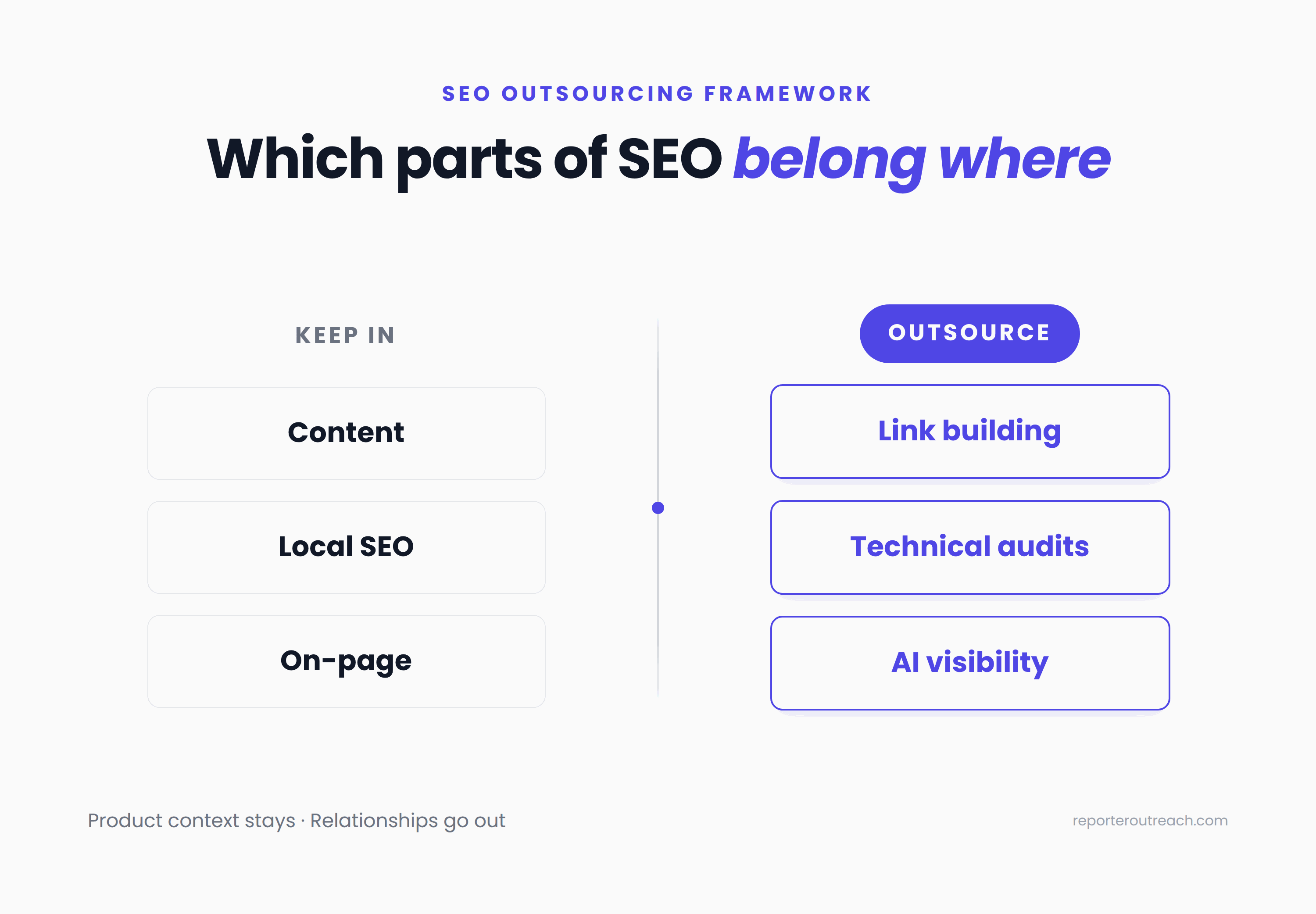
The pattern: work that hinges on product knowledge stays in-house. Work that hinges on external relationships, specialist tools, or narrow expertise goes out.
What Actually Belongs Inside Your Team
Agencies will happily take your content budget. They shouldn't.
Content strategy and writing
Your in-house marketer knows your product, your customers' objections, and how your sales team talks about the category. An external writer working from a brief will never match that — not in a year, not ever. They'll produce content that ranks for the target keyword and then fails to convert anyone because it sounds like it was written by someone who read the product page once.
Keyword research tools are easy to learn. A competent marketer picks up Ahrefs or Semrush in a few weeks. Unless you're a pre-product-market-fit startup with no one on staff who can write, content belongs inside.
High-volume content programs (10+ articles per month) are sometimes worth outsourcing the writing — but only to writers who embed with your team, interview your subject matter experts, and get edited by someone internal. Never to a content mill that writes whatever the brief says.
Local SEO management
If your business has a physical location — a dental practice, a med spa, a real estate office — Google Business Profile management, review responses, and citation hygiene are inherently internal work. The person responding to reviews should know the customers. The person adding photos should work at the location. An outsourced provider managing your GBP at arm's length will get half of it wrong.
On-page optimization and internal linking
Meta titles, descriptions, header tags, image alt text, internal link structure — none of this is hard. It takes an hour with a good checklist and knowledge of your site architecture. The only reason to outsource on-page work is if you literally don't have anyone internal who can own it.
Internal linking specifically benefits from someone who understands the full content map. An external agency opening your site fresh will always miss connections that an internal person sees instantly.
What Belongs Outside Your Team
Link building and digital PR — the strongest case for outsourcing
This is where in-house almost never works, and the reasons are mechanical.
Digital PR depends on reactive journalist sourcing — monitoring platforms where reporters post requests for expert commentary, then responding within tight windows (often under 24 hours). Doing this well requires watching those feeds every weekday, across dozens of categories, plus having the relationships to get a response read by a real journalist rather than sitting in a pile. One internal hire watching feeds part-time will miss most of the opportunities a dedicated team catches full-time.
The salary math makes it obvious:
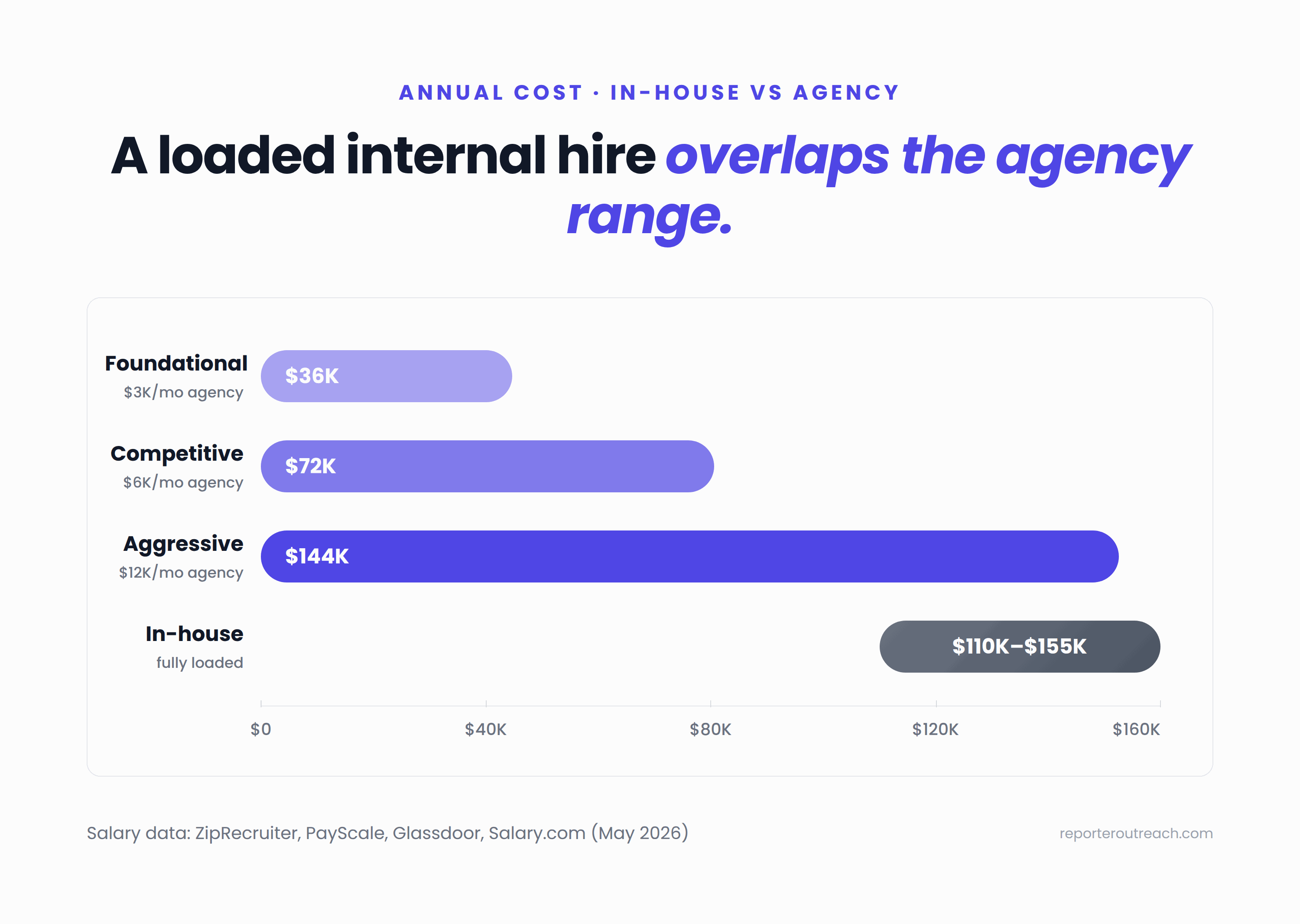
The agency route isn't always cheaper in absolute dollars — a $12K/month engagement is $144K/year, which sits inside the high end of the in-house range. But you're paying for capacity and relationships, not headcount. A single internal hire caps at their personal throughput. An agency brings a team.
The ROI math holds up too. First Page Sage's 2026 SEO ROI report puts the median return at 748% — $7.48 back on every $1 invested, with B2B SaaS specifically at 702%. Whether you spend that dollar on internal salary or agency retainer matters less than whether the work actually moves rankings.
Technical SEO audits (quarterly, not ongoing)
Technical SEO is the opposite of link building: you don't need it constantly, but when you need it, you need someone who's done it a hundred times.
A quarterly audit catches the issues that compound quietly — a sitemap silently 404ing, JavaScript rendering blocking indexation on your most important pages, a migration that broke canonical tags. These problems don't show up in traffic reports until they've already cost you months. Pay a specialist $1,500–$5,000 per audit, four times a year, and you'll catch them before they do.
The exception: if you have a development team large enough to justify an internal SEO engineer, bring it in-house. At that scale the ongoing optimizations outweigh the audit cadence.
AI search visibility
This is the newest SEO discipline, and it's where most in-house teams are furthest behind.
The primary signals that get you cited in ChatGPT, Perplexity, Gemini, and Google AI Overviews are brand mentions and editorial citations — the same outputs digital PR produces. Most in-house teams know AI visibility matters but don't have the tracking infrastructure, the monitoring setup, or the methodology yet. Building all three from scratch is a six-month project.
A specialist agency already running digital PR is producing AI visibility signals as a side effect of work they're doing anyway. You don't pay extra for it — you get it by outsourcing link building to someone who understands GEO.
The Hybrid Model Most Successful Companies Run
The best-performing SEO programs in 2026 don't pick a side. They split the work along the competence lines above:
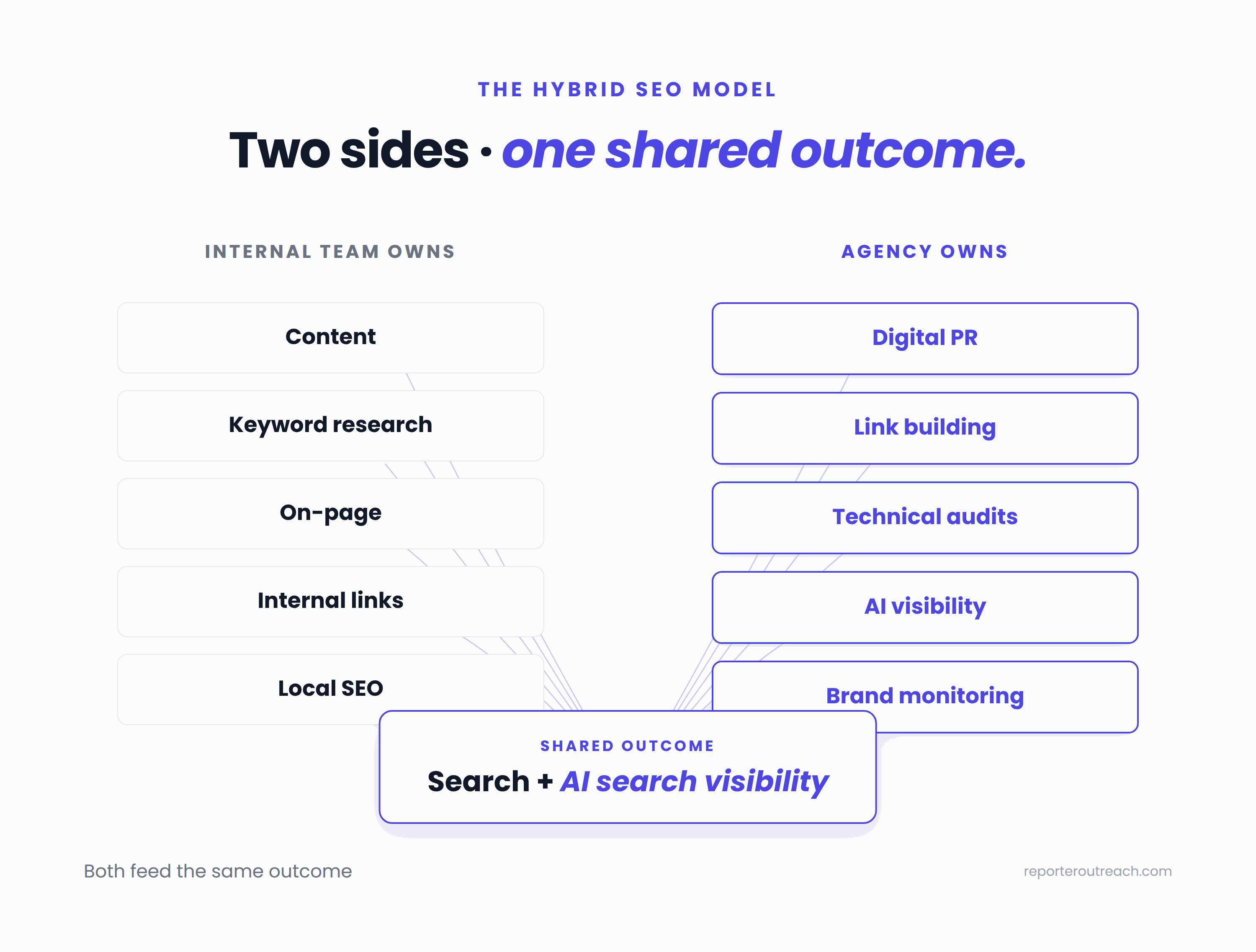
This model shows up across our client base. Nightfall — a cybersecurity SaaS company — kept its in-house team focused on product content and on-page work, and brought Reporter Outreach in for digital PR and editorial placements. Nightfall's case study shows what the split looks like in practice.
5 Signals You Should Outsource Link Building Now
These are the situations where the math almost always favors outsourcing, regardless of company size. Once the answer is yes, the next call is delivery model — the four outsourcing routes compared covers freelancers, marketplaces, agencies, and white label side by side.
- Your content is strong but rankings aren't improving. The most common pattern. You've invested in writing, on-page is clean, the pages are technically fine — and you're still stuck on page two. The missing variable is authority. Content quality alone doesn't rank in competitive verticals; you need the trust signals that come from real publications pointing at your site.
- You've tried link building internally and the pipeline is slow. One person sending pitches part-time produces a trickle. A specialist team sending them full-time, across dozens of active campaigns, produces a pipeline. If you've been trying for three months and have fewer than five quality links to show, it's not getting faster with the current setup.
- You're in a YMYL or high-competition niche. Healthcare, finance, legal, and SaaS companies compete against incumbents with 10,000+ referring domains. Nobody closes that gap with internal capacity alone.
- Your competitors have 2–5x your referring domains. Run a backlink gap analysis. If the top three competitors have 2–5x your referring domain count, you're doing the math on years of internal effort vs. months of agency work. The agency math wins.
- You want AI search visibility and don't have a plan. If competitors are getting cited in ChatGPT, Perplexity, Gemini, and AI Overviews and you're not, the fastest fix is editorial brand mentions — which you'll get as a byproduct of any serious digital PR program.
Specialist vs. Generalist: How to Tell the Difference
Most SEO outsourcing fails because companies hire a generalist agency that claims specialist results. The work ends up cookie-cutter — same pitch templates, same publisher list, same playbook the agency runs for every client — and the results match.
Here's what separates the two in practice:
| What to look at | Specialist | Generalist |
|---|---|---|
| Recent placements | Will show 5+ from the last 30 days for similar clients | "Confidential" — can't share specifics |
| Methodology | Concrete: digital PR via journalist platforms, named publishers | Vague: "outreach campaigns," "white-hat strategies" |
| Vertical experience | Specific case studies in your industry | "We work across all industries" |
| Reporting | Ranking movement, organic traffic, referring domain quality | DR improvements, total link counts |
| Pricing structure | Per-placement or retainer with deliverable scope | Flat monthly with vague output promises |
| Guarantees | No ranking guarantees — clear about what they control | "Top 3 rankings in 90 days" or similar |
One question will save you more than any checklist: "Can you show me five links you built in the last 30 days for a client in a similar industry?"
A specialist will pull up the tracker and walk you through them. A generalist will tell you they can't share that because of confidentiality. The second answer means either they don't have the links or they're worried you'll notice the sites are low-quality. Either way, move on.
The Real Risks of Outsourcing SEO
Outsourcing isn't risk-free. These are the four failure modes worth guarding against.
- Low-quality link building. Agencies on thin margins sometimes use private blog networks, expired-domain farms, or placements on sites with inflated DR but no actual traffic. These links provide zero value and can actively hurt you. Defense: require Ahrefs-verified traffic minimums on every placement, and run a quarterly backlink audit.
- Cookie-cutter strategy. Generalist agencies run the same playbook for every client regardless of industry or competitive landscape. Defense: pick an agency with vertical focus or a proven cross-industry workflow. The question "have you worked in [your industry] before?" should get a specific answer, not a vague one.
- Vanity-metric reporting. Some providers report on DR improvements or total links built without showing whether any of it moved rankings or traffic. Defense: define success metrics upfront — organic traffic growth, keyword movement, referring domain quality — and review against those, not against link counts.
- Over-dependence. If your agency owns your entire SEO strategy and you split, you lose the institutional knowledge. Defense: keep content and strategy in-house. Outsource execution, not ownership.
Budget Framework By Engagement Scale
The right outsourcing budget scales with where you are, not where you want to be. Overspending early is as bad as underspending later.
| Engagement scale | Monthly investment | What's included |
|---|---|---|
| Foundational | $3,000/mo | Reactive PR cadence on Tier 1 publications |
| Competitive | $6,000/mo | Reactive + proactive pitching on Tier 1 publications; higher placement volume |
| Aggressive | $12,000/mo | Sustained editorial cadence on Tier 1 publications; AI visibility focus |
What's worth flagging here is what stays constant across tiers: the publication caliber. All three engagement scales target Tier 1 publications. What changes is volume of placements, cadence (reactive only vs. reactive plus proactive), and whether AI visibility tracking is built into the program. Speed of first results doesn't change with budget either — first placements typically appear in 2–3 weeks regardless of tier.
From our 2026 SEO survey, 43% of in-house teams already spend $6,000+ per month on link building. If you're below that floor and competing in a hard niche, you're under-investing relative to the market.
Three-month minimum on digital PR engagements, month-to-month after that. The minimum exists because rankings shifts typically show up in months 3–6 — anything shorter and you can't fairly evaluate whether the work is moving the needle.
How to Start: A 4-Week Plan
If you've decided to outsource link building — the discipline where it matters most — here's the actual sequence to follow.
Week 1 — Baseline. Run a backlink audit on your current profile. Run a competitor gap analysis on the top three sites in your space. Identify which pages on your site most need authority support (usually the 3–5 highest-value commercial pages stuck on page 2).
Week 2 — Define the ask precisely. "We need link building" is useless. "We need 10–15 editorial links per month from DR 50+ publications in [industry] to support our [specific pages]" is a real scope. Write the one-paragraph version of this before you talk to any agency.
Week 3 — Evaluate 2–3 agencies. For each, request: a case study in your vertical, five example placements from the last 30 days, and a clear breakdown of methodology. Compare pricing against deliverables — not against each other's monthly cost.
Week 4 — Start with a 3-month commitment, not 12. Three months is the right window to evaluate communication, placement quality, and whether rankings are starting to move. Commit longer only after you've seen the work.
Outsource SEO FAQ
Should I outsource all my SEO?
No — the whole-or-nothing framing is the wrong one. Keep the work where product context matters most (content, local, on-page) and hand off the work where external relationships and specialist infrastructure drive the result (link building, quarterly audits, AI visibility). Getting that split right is the entire outsourcing decision.
How much does outsourced link building cost?
Specialist agencies typically run $3,000–$12,000 per month depending on placement volume and cadence. That includes tools, platform access, and publisher relationships you'd otherwise pay for separately. The link building pricing guide has a full breakdown by method and link type.
How do I evaluate an agency before hiring?
Three asks: recent case studies with real metrics, five example placements from the last 30 days, and a clear methodology explanation. If they can't produce all three quickly, they're either inexperienced or hiding something. Avoid any agency that guarantees specific rankings — nobody controls how Google ranks sites.
Is outsourcing link building safe?
It depends entirely on the provider. Agencies running digital PR and earning editorial links from real publications are completely safe — the links are indistinguishable from naturally earned coverage. Agencies using private blog networks, expired-domain farms, or bulk placements on low-traffic sites can cause real damage. Verify traffic and placement quality before committing.
What's a realistic timeline for results?
First placements typically appear in 2–3 weeks. Ranking shifts show up in months 3–6. More pronounced movement comes in months 6–12 as authority compounds. Competitive keywords take longer. How long link building takes has campaign-level data.
Can I outsource SEO overseas to save money?
Lower hourly rates don't translate to better value if the methodology is weak. Many offshore providers rely on tactics Google's SpamBrain detects and devalues — PBNs, low-traffic guest post networks, unnatural patterns. The quality of methodology and publisher network matters more than geography, though strong digital PR work does require native-fluent writers with access to English-language journalist platforms.
Outsource the Part That Actually Matters.
Tell us which pages need authority and which publications you'd want coverage from. We'll send back a specific plan — real deliverables, real timeline, no ranking guarantees.
Sources
Reporter Outreach 2026 SEO survey; First Page Sage 2026 SEO ROI report (median 748%); Ahrefs public pricing (April 2026); ZipRecruiter, PayScale, Glassdoor, and Salary.com SEO specialist compensation data (May 2026).